An Industry is Booming in the Nation’s Capital

If you’re looking for recreational marijuana in Washington D.C., there is an app for that.

In the spring of 2017, residents in the nation’s capital can choose from a selection of services that will deliver marijuana to their doors. A number of websites offer marijuana “meet-ups” where, after the purchase of a $50 t-shirt, bottle of water or sticker, marijuana will be “gifted” with a wink and a nod. On any given night a cannabis-friendly inhabitant can most likely find a marijuana themed event at a local bar in their neighborhood, in seeming defiance of federal law.

At a time when the city is adjusting to the Trump presidency and Attorney General Jeff Sessions is threatening federal enforcement in states where marijuana prohibitions have been eased, a burgeoning, if not booming marijuana industry is growing in Washington D.C. right outside their doors.

The District vs. The U.S. Congress

In 2014 Washington D.C. voters approved a ballot initiative known as Initiative 71.  The measure allows for “possession, purchase, and transportation of up to two ounces of marijuana for personal use,” as well as “personal cultivation of up to six marijuana plants,” and “transfer of up to one ounce of marijuana” between adults.  It was overwhelmingly approved with nearly 70% of district voters voting in favor.

The initiative took effect in early 2015 and the city’s underground marijuana users began to come out of the shadows.  While medical marijuana had been legal since 2010, prior to Initiative 71 only one medical marijuana dispensary had opened in the district.  Federal restrictions on marijuana in general had prevented others from following suit.  Initiative 71 changed that.  If marijuana was legal for personal use, then medical use was thought to be a no brainer.

There are currently five licensed medical marijuana dispensaries and eight licensed marijuana cultivation centers.  Jennifer Brunenkant, a managing member of Herbal Alternatives – one of the five dispensaries, says that the marijuana industry in D.C. is much more restrictive than in states with comparable laws.

“D.C. is much more structured,” she said in a telephone interview.  “The application process took more than a year and our product is constantly monitored” by the D.C. Department of Health and D.C.’s local police, the MPD.

In order to maintain their licenses, the dispensaries are subject to inventory control.  The patients with medical cards are required to register with a dispensary and also have a limit on the amount of marijuana that they can purchase within a 30 day period.  The department of health might stop by and inspect the dispensary at any time, much like a spot inspection of a restaurant kitchen.

According to Brunenkant, taxation has been one of the biggest hurdles on the road to legitimacy for Herbal Alternatives and the other medical dispensaries. Federal law maintains that marijuana is a Schedule-1 narcotic, therefore the IRS deems medical marijuana to be an illegal product, despite the local legal status.  Brunenkant pays her federal income tax but is not allowed to deduct normal business expenses like advertising, payroll, or equipment investments.  This discrepancy means the cost of doing business is much higher than it would be in almost any other industry.

Credit cards pose another problem for the dispensaries.  Most credit card companies are inter-state businesses, which means that any credit card transaction would at some point cross a state line.  Banks fear that any interstate transaction might violate federal restrictions,  so they refuse to deal with medical dispensaries.  For D.C. medical marijuana businesses, that means either dealing with cash only, or finding a local credit union which will accept their credit transactions.  Brunenkant says these restrictions have led some dispensaries to mask the product which is being purchased in order to side step the credit card companies’ constraint.

Federal restrictions also place tight controls on who might be able to do research related to medical marijuana.  For Brunenkant this means that the best science related to marijuana is coming from overseas.  She says doctors are reluctant to prescribe or recommend cannabis because “there isn’t a book that tells them to take 5mg of this particular strain, so they don’t know how much or what kind,” of marijuana to prescribe.

“We’re not going away.” – Adam Eidinger

Tucked into an unassuming row house on Embassy Row, sandwiched between the Embassy of Mexico and the Embassy of Japan is Washington D.C.’s unofficial Embassy to marijuana.  The row house is the headquarters of the advocacy group DCMJ, formerly known as the Cannabis Campaign.  DCMJ is the group responsible for Initiative 71, having written the legislation themselves, gathered the necessary signatures to get it onto the ballot and rallied support among voters.

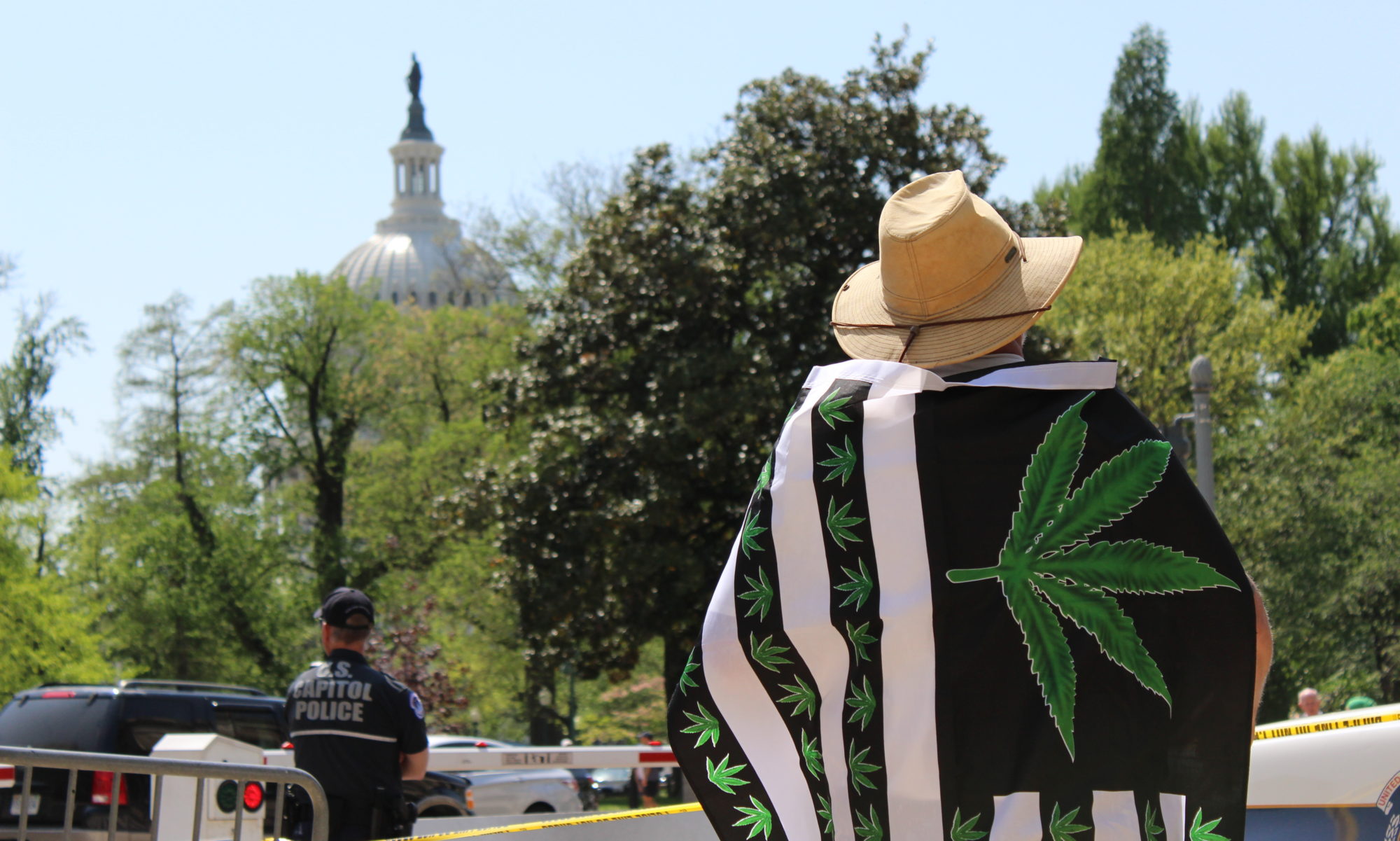
Adam Eidinger is the co-founder of the group and on April 13, 2017 he was at headquarters, sewing the signature Phrygian caps donned by DCMJ volunteers at their rallies.  15 volunteers were seated nearby at a table loaded with marijuana, rolling papers and mason jars full of joints.  The group was preparing for a rally on April 20 at the U.S. Capitol building where they planned to give the joints away to congressional staffers and journalists.  The giveaway was meant to raise awareness about D.C.’s unusual legal status and the inconsistencies between city and federal laws.

“This is what activism is about, it’s not just voting,” Eidinger said.  “The problem is the law, Congress is preventing our local government from actually writing it’s own laws.”

Eidinger is referring to the Harris Rider, sponsored by Andy Harris (R-Md), which was inserted into an Congressional omnibus spending bill shortly after the district voted for Initiative 71.  The rider blocks the district government from spending any money on implementation of the law, which means that even a city council meeting to discuss Initiative 71 could be considered a violation of federal law and city council members could face arrest.

“We have a city government, we’ve balanced our budgets, we have the tax revenue to pay for this program on our own, we don’t need the federal funds.” he continued.  “The congressional rider is wholly undemocratic.”

Eidinger was arrested twice within the span of one week for civil disobedience on Capitol Hill.  At the giveaway on April 20th, he was arrested along with seven other activists by Capitol Police.  The six other activists had their charges dropped, but Eidinger was charged with distribution of cannabis after spending the night in jail.  Four days later, Eidinger was arrested by Capitol Police again, this time for possession of marijuana, which is explicitly legal in the District, but still illegal under federal law.

“We’re calling on congress to change the damn law.” said Nikolas Schiller, DCMJ’s other co-founder.

Eidinger’s arrests highlight the discrepancies between federal and city law.  On April 20th, the group had specifically chosen the location of the give away to be as close to the Capitol building as possible without actually being on federal land.  On one side of the street, Eidinger argues, the jurisdiction should have been MPD, D.C. police.  On the other side of the street, the jurisdiction would have been the Capitol Police, federal law enforcement.

To further complicate matters, all drug arrests in the District of Columbia are handled by the U.S. attorney.  Any other crime in the district would be handled by the district attorney, just like every other jurisdiction in the country.
“Most people have never seen that much weed in one place.” – Princess Mirabel

Princess Mirabel is an entrepreneur.  Her promotion company, Cannabis Karma, hosts weekly marijuana themed events around the city.  She operates like a concert promoter, finding the venue, arranging the vendors and getting publicity.

On April, 17, 2017 her company held it’s weekly event at Dirty Bar, a third floor lounge above the popular Dupont Circle night spot Dirty Martini.  Multiple vendors lined up outside the bar an hour before opening, waiting to get in and set up tables with their marijuana cookies, pipes and plants.

The scene inside looked more like Amsterdam than Washington D.C. and the smell of marijuana smoke filled the room.

“There are a lot of weekly events around town, this is just one example.”  she said.  “Campsterdam, Taco Tuesdays, Hash District at the Layla lounge.  They’ve all got their own vibe, their own demographic.  Most people have never seen that much weed in one place.”

The events are marketed on Instagram, Reddit and other social media sites as “420 friendly” or “Initiative 71 compliant,” with the implication that one might have marijuana in their possession, but it’s not being sold or purchased.

Jennifer Brunenkant says that while she supports full legalization, this “gray market” is bad for business.  “Gifting is not a thing.  It’s not legal and there is no loop-hole in the law. There’s no such thing as an Initiative 71-compliant event or delivery service.”

Adam Eidinger agrees.  “The people voted for this and it’s definitely what they want, but Congress is blocking us from enacting any kind of tax and regulate legislation, so gifting has become a thing.”

“Good people don’t smoke marijuana.” – Jeff Sessions

Legal Cannabis Numbers

Legal Cannabis Sales Nationwide (2016)Source - Forbes.com
Projected Legal Cannabis Sales Nationwide (2020)Source - Forbes.com
Tax Revenue from Legal Cannabis in Colorado (2016)Source - Fortune.com
Projected Jobs in Legal Cannabis Industry (2020)Source - Fortune.com
States with Legal Marijuana (Medical and/or Recreational)Source - Data.world

As public opinion has shown increasing approval of eased marijuana prohibitions, some lawmakers have begun to take notice.  D.C. city officials have long been on record as supporting Initiative 71, even if only from a home rule perspective.  Former Mayor Vincent Gray and current Mayor Muriel Bowser both campaigned on the issue in their 2014 election and the D.C. city council has also shown majority support.

The newly formed Congressional Cannabis Caucus aims to address some of the discrepancies between local and federal laws. The bipartisan group formed by Earl Blumenauer (D-Or),  Jared Polis (D-Co), Don Young (R-Ak) and Dana Rohrabacher (R-Ca) was formed in 2017, shortly after Attorney General Jeff Sessions was confirmed.  The caucus received widespread media attention by announcing their intention to harmonize conflicting federal and state laws.  The question remains whether D.C. would be included in this harmony because of it’s unique status as a federal district.

In April, 2017 Congressman Ed Perlmutter (D-Co) introduced legislation to protect banks who decide to deal with “cannabis-related legitimate businesses.”  The bill had 28 co-sponsors and was referred to the judiciary committee.

In May 2017, Congressman Tom Garrett (R-Va) will introduce a bill which would remove marijuana from the list of federally controlled substances.  This legislation would seem to have the biggest overall impact by specifically making marijuana a state by state issue.  Banks and credit companies would be able to choose whether or not to do business with cannabis companies, medical research could be performed more easily and the federal government would no longer have the power to arrest individuals for any marijuana related crime in states and localities where restrictions have been eased. 

As Jennifer Brunenkant is working diligently to pay her taxes and maintain control of her inventory, and Adam Eidinger is plotting the legal defense for his civil disobedience on Capitol Hill, Princess Mirabel is planning another marijuana event where she is expecting more than 400 people to attend. While she insists that no cannabis related products will be bought or sold, if you give a donation, marijuana will be gifted.